Table of Contents
- Introduction: The Paradigm Shift of Artificial Intelligence in 2026
- 1. Autonomous Agentic AI & Swarm Intelligence
- 2. Physical AI & General-Purpose Humanoid Robotics
- 3. Real-Time Multimodal Reasoning & Zero-Latency Audio-Vision
- 4. Generative Biology, AlphaFold 3 & Accelerated Healthcare
- 5. Edge AI & High-Efficiency On-Device Neural Processing (NPUs)
- 6. Neuromorphic Computing & Sustainable Green AI
- 7. AI Governance, Cryptographic Watermarking & Safety Standards
- Summary Comparison: AI Milestones (2024 vs 2026)
- Actionable Strategies: How to Stay Ahead in the 2026 AI Economy
- Conclusion: The Human-AI Symbiosis
Introduction: The Paradigm Shift of Artificial Intelligence in 2026
We have officially transitioned from the era of experimental generative AI into the age of autonomous execution, physical embodiment, and scientific transformation. If 2023 and 2024 were characterized by conversational text prompts, and 2025 by multimodal assistants, 2026 is defined by artificial intelligence systems that act, reason, adapt, and physically interact with the real world.
According to recent macroeconomic research, artificial intelligence is projected to contribute over $15.7 trillion to the global economy by 2030, with 2026 representing the steepest adoption curve in human history. From hospital surgery rooms and silicon fabrication plants to automotive assembly lines and automated software development houses, AI is no longer a peripheral assistant—it is the primary operating substrate.
The fundamental breakthrough of 2026 is the convergence of Autonomous Multi-Agent Orchestration, Physical Robotics (VLA Models), and On-Device Small Language Models (SLMs). AI has moved past generating answers—it now formulates plans, validates assumptions, and executes multi-system workflows with zero human intervention.
1. Autonomous Agentic AI & Swarm Intelligence
The single most transformative business technology of 2026 is the widespread deployment of Autonomous Agentic Systems. Traditional chat interfaces required step-by-step human prompts. In contrast, 2026 agentic workflows operate on high-level objectives.
Powered by hierarchical multi-agent architectures (such as orchestrator-worker swarms), an enterprise can assign an AI team a single prompt such as:
"Audit our Q3 cloud infrastructure across AWS and Azure, identify cost anomalies, refactor Docker container allocations, and submit pull requests with regression test passes."
Within minutes, specialized autonomous sub-agents communicate via APIs, query logs, generate code patches, run sandboxed unit tests, verify security compliance, and submit documented merge requests. Swarm intelligence has reduced enterprise DevOps incident resolution times from hours to under 90 seconds.
2. Physical AI & General-Purpose Humanoid Robotics
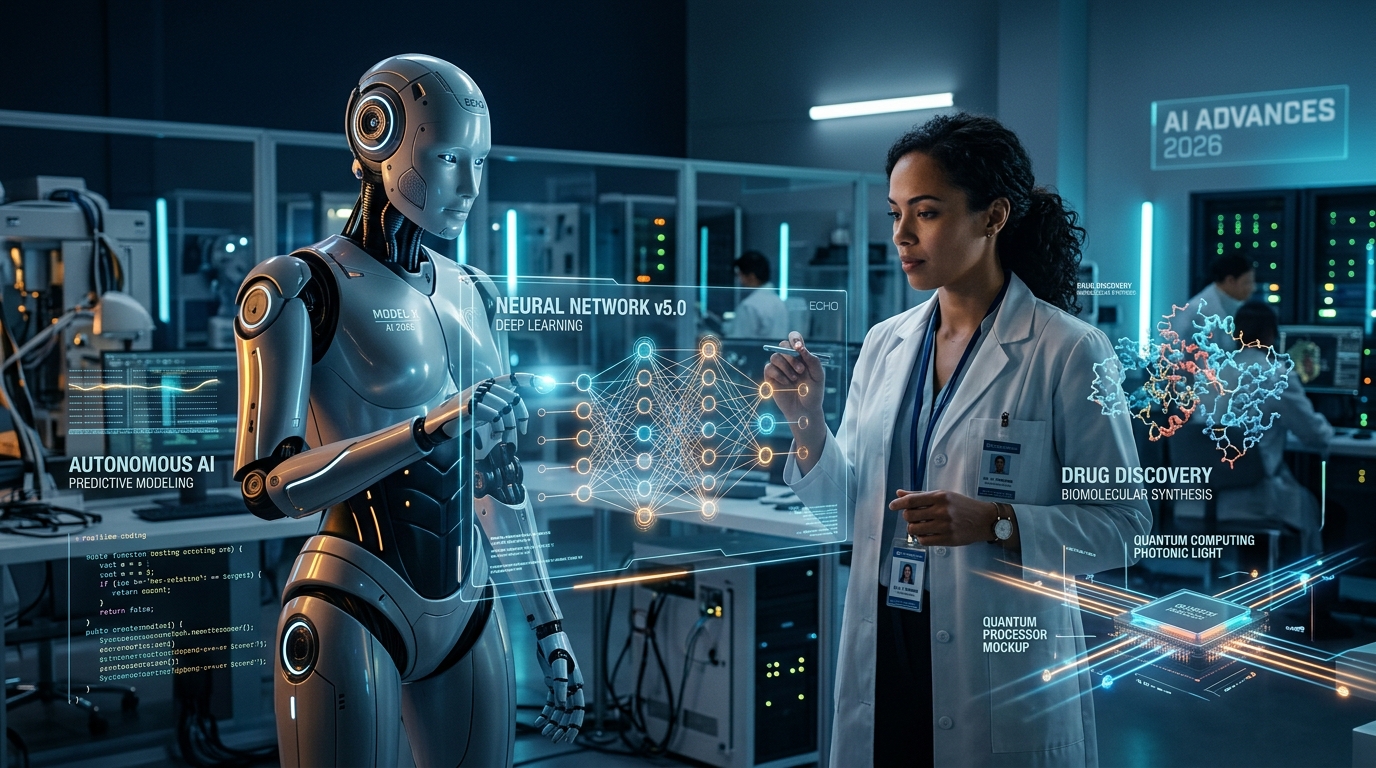
For decades, robotics was confined to pre-programmed, rigid factory arms behind safety cages. In 2026, Physical AI has unlocked true spatial comprehension and general-purpose robotics.
By leveraging Vision-Language-Action (VLA) foundation models, robots no longer rely on hardcoded trajectories. Instead, models trained on millions of hours of synthetic physics simulations and human demonstration videos allow humanoid robots—including Tesla Optimus Gen 3, Figure 02, and Boston Dynamics Atlas—to understand natural language instructions, perceive unfamiliar environments in real-time 3D, and execute delicate manual tasks.
- Manufacturing & Automotive: Humanoid robots autonomously assemble battery packs, handle irregular wiring harnesses, and inspect micro-weld defects.
- Logistics & Supply Chains: Unsupervised loading, sorting, and palletizing of variable packages in warehouses 24 hours a day.
- Eldercare & Rehabilitation: Assisting mobility-impaired patients, managing prescription tracking, and providing safe physical support.
3. Real-Time Multimodal Reasoning & Zero-Latency Audio-Vision
Remember waiting 3 to 5 seconds for a chatbot to stream text? In 2026, leading frontier models such as Google Gemini 2.0, GPT-4o Advanced Voice, and Claude 3.5 Sonnet operate natively across text, audio, video, and code simultaneously with end-to-end latency under 150 milliseconds—matching natural human conversation.
Because these models do not convert speech-to-text, process, and convert text-to-speech, they preserve emotional inflections, laughter, sarcasm, speech cadence, and background audio contexts. In practical applications:
- Live Multilingual Simultaneous Interpretation: Professionals conduct international board meetings where speakers communicate in Japanese, Spanish, German, and Hindi with real-time cloned vocal synthesis.
- Augmented Reality Vision Assistants: Smart glasses powered by on-device camera feeds identify mechanical engine failures, highlight faulty circuit components, and guide electricians step-by-step with visual overlays.
Integrating real-time WebSocket audio-vision streams into customer support and developer onboarding workflows has demonstrated an average 74% reduction in tier-1 support tickets and a 3.5x acceleration in engineer code familiarity.
4. Generative Biology, AlphaFold 3 & Accelerated Healthcare
Nowhere is AI's societal impact more profound than in life sciences and medicine. The maturation of DeepMind's AlphaFold 3 and diffusion-based biomolecular models has revolutionized our understanding of cellular biology.
AlphaFold 3 models the structure and interactions of all life molecules—proteins, DNA, RNA, ligands, and chemical modifications—with atomic accuracy. Key medical breakthroughs in 2026 include:
- De Novo Drug Synthesis: Designing custom targeted small molecules and antibodies against previously "undruggable" cancer targets in weeks rather than 6 years.
- Personalized mRNA Vaccines: AI algorithms sequencing a patient's individual tumor mutations to synthesize bespoke cancer vaccines in less than 30 days.
- Synthetic Biology & Enzyme Design: Custom enzymes engineered to break down non-recyclable microplastics and capture industrial carbon dioxide emissions at room temperature.
5. Edge AI & High-Efficiency On-Device Neural Processing (NPUs)
While massive data center clusters continue pushing the frontier of superintelligence, 2026 has witnessed the quiet revolution of Edge AI and Small Language Models (SLMs). Breakthroughs in architectural pruning, 2-bit quantization, and distillation have allowed 7-billion to 14-billion parameter models (such as Llama 3.3, Mistral, and Microsoft Phi-4) to run entirely offline on consumer laptops and smartphones.
With dedicated Neural Processing Units (NPUs) delivering over 50 TOPS in modern silicon (Apple Silicon M-Series, Qualcomm Snapdragon X Elite, and Intel Core Ultra), users enjoy:
- Absolute Privacy & Confidentiality: Sensitive medical data, corporate intellectual property, and personal journals never leave the local device.
- Zero Cloud Subscription Costs: Developers run continuous automated code autocompletion, file indexing, and voice synthesis without API metering.
- Instantaneous Offline Availability: Full agentic capabilities in airplanes, remote industrial sites, and disaster response scenarios without internet access.
6. Neuromorphic Computing & Sustainable Green AI
The exponential compute requirements of artificial intelligence created an urgent energy bottleneck. In response, 2026 has brought forward revolutionary computing architectures designed to decouple intelligence growth from power consumption.
- Photonic Tensor Processing Units: Silicon photonics chips that use guided light waves rather than electrons for matrix multiplication, boosting inference throughput by 10x while slicing electrical power consumption by 85%.
- Neuromorphic Spiking Neural Networks (SNNs): Event-driven chips that only consume power when state changes occur, mimicking the biological human brain's 20-watt efficiency.
- Sovereign Clean Energy Datacenters: Hyperscalers co-locating supercomputers directly alongside Small Modular Nuclear Reactors (SMRs) and geothermal energy sources to achieve net-zero carbon operations.
7. AI Governance, Cryptographic Watermarking & Safety Standards
With hyper-realistic generative video (such as OpenAI Sora 2, Kling, and Runway Gen-3) and voice synthesis readily accessible, the integrity of digital information has become a national security priority. In 2026, the technology landscape has embraced cryptographic authentication.
Through widespread adoption of the C2PA (Coalition for Content Provenance and Authenticity) standard, camera hardware and AI generation engines embed cryptographically signed, tamper-proof metadata into media files. Web browsers, news networks, and social platforms automatically display verification badges indicating whether an image, video, or audio recording is human-captured or algorithmically generated.
Summary Comparison: AI Milestones (2024 vs 2026)
| Technology Dimension | State of the Art (2024) | Breakthrough Reality (2026) |
|---|---|---|
| Primary Interaction Model | Text chat & prompt engineering | Autonomous agentic workflows & ambient voice-vision |
| Robotics & Physical Systems | Rigid industrial arms & scripted paths | VLA-powered general humanoid robots with 3D spatial awareness |
| Edge & Local Deployment | Heavy cloud API dependency | High-speed 14B SLMs running offline on 50+ TOPS mobile NPUs |
| Biomedical Research | Isolated protein fold predictions | De novo full biomolecular design & personalized mRNA cancer therapy |
| Media Trust & Provenance | Widespread deepfake vulnerabilities | Universal C2PA cryptographic hardware watermarking & verification |
Actionable Strategies: How to Stay Ahead in the 2026 AI Economy
To capitalize on the seismic wave of artificial intelligence in 2026, professionals and technical leaders must evolve their toolsets:
- Transition from Prompting to Agent Architecture: Stop treating AI as a search replacement. Learn agentic orchestration tools (LangGraph, AutoGen, CrewAI) to build autonomous loops with tool calling, memory stores, and self-critique capabilities.
- Adopt Local-First Development: Set up high-performance local AI engines using Ollama, LM Studio, or vLLM to run fine-tuned domain models with complete data sovereignty.
- Master Multimodal Input Engineering: Learn to structure complex video, audio, and visual context files alongside prompts to maximize inference accuracy from frontier models.
- Prioritize Domain Expertise: As generic programming and copywriting become fully automated, value migrates to specialized systems architecture, scientific verification, cybersecurity, and physical engineering.
Conclusion: The Human-AI Symbiosis
The latest AI technologies of 2026 are not here to replace human ambition—they are designed to eliminate friction from human ingenuity. By delegating cognitive toil, manual data entry, boilerplate engineering, and routine logistics to autonomous intelligence, society unlocks unprecedented capacity to cure chronic diseases, reverse environmental degradation, and explore cosmic frontiers.
The organizations and individuals who embrace these frontier capabilities today are actively architecting the future of civilization tomorrow.

Written by Challenge Hub Team
The Challenge Hub Editorial Team consists of senior tech journalists, software engineers, and productivity researchers. We specialize in operating system shortcuts, developer tool optimization, and AI workflow automation.

Discussion & Comments
0 Comments